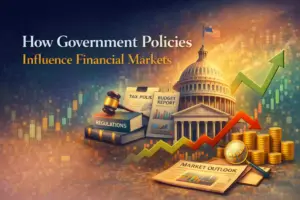
Government policies play a fundamental role in shaping financial markets by setting the legal, fiscal, and regulatory frameworks within which banks, investors, and corporations operate. Decisions related to taxation, public spending, financial regulation, trade policy, and monetary coordination influence capital allocation, risk perception, and market confidence. Banking systems act as transmission channels for many of these policies, translating legislative and executive decisions into credit conditions, liquidity availability, and pricing across the economy. Financial markets respond continuously to policy signals, adjusting asset valuations and capital flows as expectations evolve.
At a global level, policy coordination—or the lack thereof—can amplify or moderate market reactions. Expansionary fiscal measures may support growth expectations, while tighter regulations can reshape profitability and risk-taking across sectors. Monetary authorities, often operating independently but within government-mandated frameworks, further influence market dynamics through interest rate and liquidity policies. For informational comparison only, professionals working in policy-sensitive roles—such as public policy analysis, regulatory strategy, or macroeconomic research—may earn hourly-equivalent compensation ranging from approximately USD 50 to over USD 130 in major financial centers over established career paths. These figures are descriptive, vary by region and institution, and do not imply guaranteed outcomes.
2. What Does Banking & Market Sponsorship Mean in the Context of Government Policies
In the context of government policies, banking and market sponsorship refers to how financial institutions provide structured support to economic activity while aligning with legislative and regulatory requirements. Financial sponsorship may include extending credit under policy-driven incentives, participating in government-backed lending programs, or underwriting securities aligned with public financing needs. These activities are conducted within compliance frameworks that reflect laws, supervisory guidance, and public policy objectives.
Institutional backing and capital support are influenced by policy decisions affecting capital requirements, liquidity rules, and risk-weighting standards. For example, regulatory reforms can alter how banks allocate balance-sheet capacity, while fiscal initiatives can create demand for financing through public-private partnerships. Market sponsorship in this setting reflects systemic alignment with government objectives—such as stability, growth, or inclusion—rather than promotional or outcome-based guarantees.
3. How Can Professionals Find Banking or Financial Market Opportunities Related to Government Policy Abroad
Professionals seeking international roles connected to government policy and market impact typically rely on transparent and regulated pathways, including:
-
International Banks: Multinational banks recruit policy analysts, regulatory strategists, and risk professionals to navigate policy environments across jurisdictions.
-
Investment Firms: Asset managers and research institutions employ analysts to assess how fiscal and regulatory policies affect markets and sectors.
-
Public Financial Institutions: Central banks, development banks, and supervisory authorities offer roles related to policy design, implementation, and oversight.
-
Policy and Research Organizations: Think tanks and academic institutes provide cross-border opportunities in economic and financial policy analysis.
-
Regulated Recruitment Channels: Licensed recruitment firms specializing in financial services facilitate compliant international hiring.
These pathways are informational and depend on regulatory approval, institutional demand, and individual qualifications.
4. Salary Expectations for Banking & Financial Market Professionals Focused on Policy Analysis
| Job Title | Region / Market | Estimated Hourly Salary | Average Annual Range |
|---|---|---|---|
| Financial Policy Analyst | North America | USD 55–90 | USD 110,000–180,000 |
| Regulatory Strategy Manager | Europe | EUR 45–80 | EUR 90,000–150,000 |
| Public Policy Economist | Asia-Pacific | USD 50–85 | USD 100,000–170,000 |
| Government Relations Specialist (Finance) | Middle East | USD 40–70 | USD 80,000–140,000 |
| Macro Policy Research Analyst | Global Markets | USD 55–95 | USD 110,000–190,000 |
Summary: Compensation in government policy–related banking and market roles varies based on jurisdiction, regulatory complexity, institutional scope, and professional experience. The figures above are indicative averages and not guaranteed compensation levels.
5. Institutions Central to Government Policy and Market Influence
Several institutions play key roles in shaping, implementing, or analyzing government policies and their market impact:
-
International Monetary Fund – Analyzes fiscal, monetary, and structural policies and their implications for global financial stability.
-
World Bank – Supports policy reforms and financing frameworks that influence emerging and developing financial markets.
-
Federal Reserve – Implements monetary policy within a government-mandated framework, influencing global financial conditions.
-
European Central Bank – Oversees monetary policy and contributes to regulatory standards affecting euro area markets.
-
Bank for International Settlements – Facilitates cooperation among central banks and supports policy coordination affecting global markets.
These entities are referenced for factual context only and do not imply endorsement or employment outcomes.
6. Visa Types and Legal Options for Banking & Financial Market Professionals
Banking and financial market professionals working abroad in roles related to government policy must comply with immigration, labor, and financial regulations in the host jurisdiction. Common pathways include skilled professional visas, research-based permits, and intra-company transfer visas for multinational institutions. Eligibility typically depends on recognized qualifications, verified experience, and sponsorship by an authorized employer. Professionals should consult official government immigration authorities and financial regulators for accurate and current guidance. No legal or employment outcomes are guaranteed.
7. Where to Find Banking & Market Opportunities Related to Government Policy
Banking & market opportunities linked to government policy analysis and implementation are commonly found through:
-
Financial news platforms covering fiscal policy, regulation, and macroeconomic developments
-
Official career portals of banks, central banks, and public financial institutions
-
Institutional recruitment channels operated by multilateral organizations and regulators
-
Professional economic, legal, and financial associations with accredited job listings
These sources emphasize transparency, credibility, and regulatory compliance.
8. How to Apply for Banking & Financial Market Roles Focused on Government Policy
Applying for banking & financial market roles related to government policy typically follows a structured process:
-
Confirm Academic Qualifications – Degrees in economics, finance, public policy, or law are commonly required.
-
Demonstrate Relevant Experience – Experience in regulatory analysis, policy research, or financial supervision is often assessed.
-
Prepare Formal Documentation – Applications usually require standardized resumes, certifications, and verified professional references.
-
Undergo Compliance and Background Checks – Regulatory and institutional screening is standard across financial sector hiring.
-
Apply Through Official Channels – Applications are submitted via institutional career portals or regulated recruitment frameworks.
This overview is informational and may vary depending on jurisdiction, institution, and prevailing policy conditions.
Disclaimer:
This article is for informational purposes only and does not constitute financial or investment advice.
Related Articles
- Financial Market Insights for Beginners
- Economic Indicators Every Market Follower Should Track
- Banking Industry Risks and Stability Reports
- Interest Rates vs Inflation: What Investors Should Know
- Market Outlook: What Analysts Predict for the Coming Months
- Banking Sector Earnings Reports Explained
- Stock Market Volatility: Causes and Effects